The finance industry is undergoing one of the biggest transformations in history. Artificial Intelligence (AI), automation, digital payments, blockchain, cloud accounting, and financial analytics are changing how businesses manage money and make decisions. As a result, career opportunities in Finance, Accounting, and FinTech are expanding rapidly.
Students often ask:
- Which career offers the highest salary?
- Which field has the best future scope?
- Should I choose Finance, Accounting, or FinTech?
- Which course is best after 12th or graduation?
The answer depends on your interests, career goals, and the type of work you enjoy. This guide compares Finance, Accounting, and FinTech in terms of job roles, skills, salaries, industry demand, and long-term growth to help you make an informed decision.
Understanding the Three Career Paths
Although these fields are closely connected, each focuses on different aspects of business and financial management.
Finance
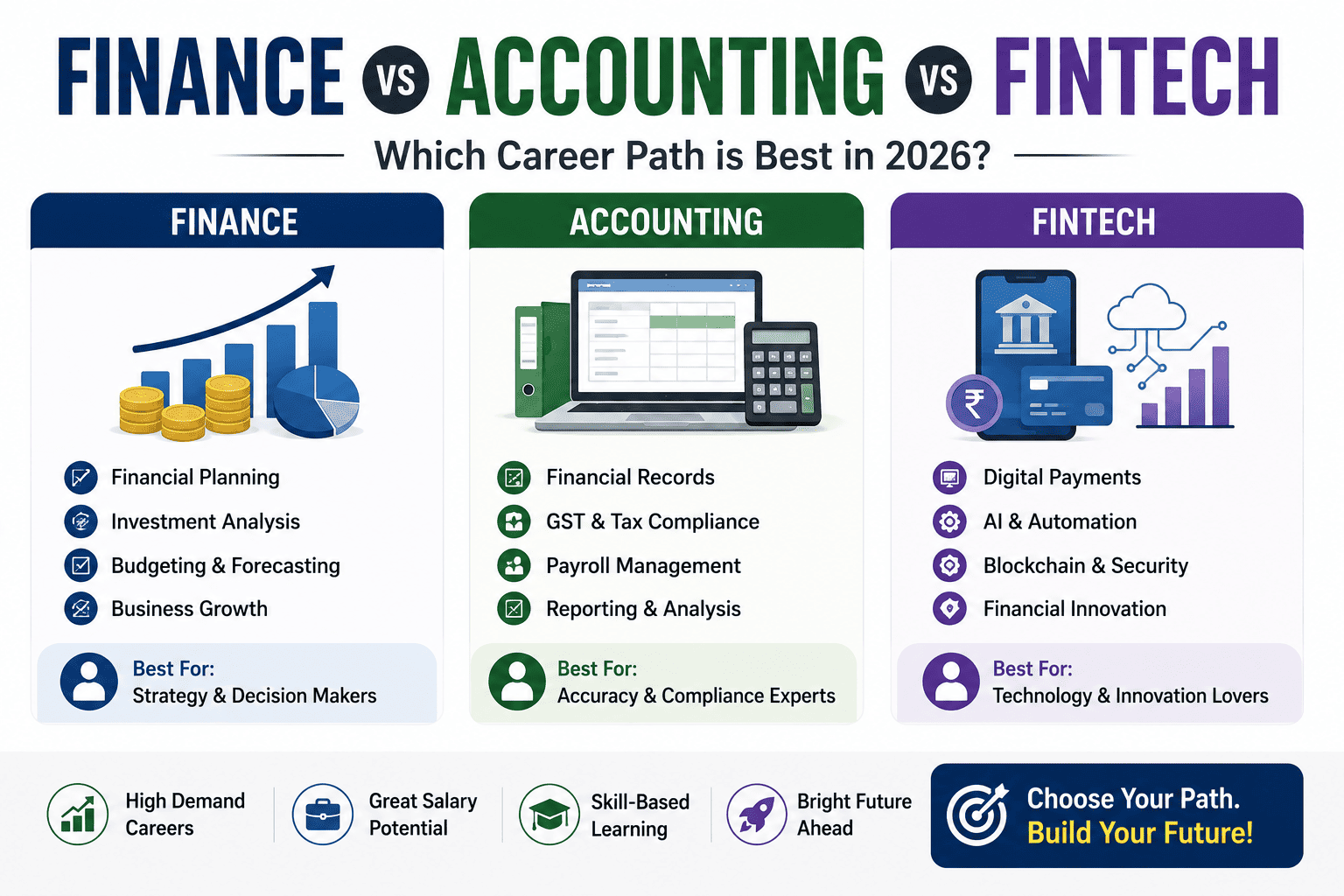
Finance focuses on managing money, investments, budgeting, business planning, risk management, and financial decision-making. Finance professionals help organizations improve profitability and plan for future growth.
Accounting
Accounting focuses on recording, organizing, reporting, and auditing financial transactions. Accountants ensure businesses maintain accurate records and comply with taxation and financial regulations.
FinTech
FinTech (Financial Technology) combines finance with modern technologies such as AI, digital payments, blockchain, automation, cloud computing, and data analytics to create innovative financial solutions.
Quick Comparison
| Feature | Finance | Accounting | FinTech |
|---|---|---|---|
| Primary Focus | Business Finance | Financial Records & Compliance | Technology + Finance |
| Learning Difficulty | Medium | Easy–Medium | Medium |
| Technology Usage | High | Moderate | Very High |
| Industry Demand | High | Very High | Extremely High |
| Salary Growth | Excellent | Good | Outstanding |
| Future Scope | Excellent | Excellent | Exceptional |
What You’ll Learn
Finance
Typical topics include:
- Financial Management
- Budgeting
- Investment Analysis
- Financial Planning
- Risk Management
- Corporate Finance
- Business Finance
Accounting
Core topics include:
- Financial Accounting
- Tally Prime
- GST
- Payroll
- TDS
- Inventory Management
- Financial Statements
- Banking
FinTech
A modern FinTech curriculum often covers:
- Digital Banking
- Online Payments
- AI in Finance
- Financial Analytics
- Blockchain Fundamentals
- Robo-Advisory Concepts
- Financial Planning
- Data-Driven Decision Making
Career Opportunities
Finance Careers
Popular job roles include:
- Financial Analyst
- Finance Executive
- Investment Analyst
- Credit Analyst
- Budget Analyst
- Treasury Executive
- Relationship Manager
Average Salary
₹4–8 LPA (Freshers)
Accounting Careers
Popular job roles include:
- Accountant
- Accounts Executive
- GST Executive
- Payroll Executive
- Tax Assistant
- Accounts Officer
- Audit Assistant
Average Salary
₹3–6 LPA (Freshers)
FinTech Careers
Popular job roles include:
- FinTech Executive
- Digital Banking Executive
- Financial Planning Associate
- Payment Operations Executive
- FinTech Analyst
- Financial Data Analyst
- Product Support Executive
Average Salary
₹5–10 LPA (Freshers)
Salary Comparison
| Experience | Finance | Accounting | FinTech |
|---|---|---|---|
| Freshers | ₹4–8 LPA | ₹3–6 LPA | ₹5–10 LPA |
| 2–5 Years | ₹7–12 LPA | ₹5–8 LPA | ₹8–15 LPA |
| Experienced | ₹12–25+ LPA | ₹8–15 LPA | ₹15–30+ LPA |
Skills Employers Look For
Finance Professionals
- Financial Analysis
- Budgeting
- Forecasting
- Business Planning
- Advanced Excel
- Power BI
- Financial Reporting
- Communication Skills
Accounting Professionals
- Tally Prime
- GST Compliance
- Payroll Processing
- TDS
- Banking
- MIS Reporting
- Advanced Excel
- Attention to Detail
FinTech Professionals
- Financial Planning
- Digital Payments
- AI Tools
- Financial Analytics
- Power BI
- Advanced Excel
- Data Interpretation
- Business Intelligence
Industries Hiring
Finance
- Banking
- Investment Firms
- Insurance
- Corporate Finance Departments
- NBFCs
- Consulting Companies
Accounting
- CA Firms
- Manufacturing Companies
- Retail Businesses
- Healthcare
- Logistics
- Educational Institutions
- SMEs
- MNCs
FinTech
- Digital Payment Companies
- FinTech Startups
- Digital Banks
- Wealth Management Firms
- InsurTech Companies
- Lending Platforms
- Financial Service Providers
Which Career is Easier to Start?
Accounting
The easiest entry point for beginners. Ideal for students after 12th or graduation who want practical job-ready skills quickly.
Finance
Suitable for students interested in business strategy, financial planning, investments, and corporate decision-making.
FinTech
Ideal for learners who enjoy technology, innovation, digital finance, and analytics. It combines financial knowledge with emerging technologies.
Future Scope in 2026
Finance
Finance professionals will continue to play a critical role in business planning, investment management, and corporate growth. Demand remains strong across industries.
Accounting
Accounting remains an essential function for every organization. Professionals who combine accounting with digital tools and analytics will enjoy stronger career prospects.
FinTech
FinTech is one of the fastest-growing sectors globally. As businesses adopt AI, digital banking, blockchain, and automation, demand for FinTech professionals is expected to increase significantly.
Which Course Should You Choose?
Choose Finance If:
- You enjoy business strategy.
- You are interested in investments and financial planning.
- You want leadership opportunities in corporate finance.
Choose Accounting If:
- You like working with numbers and compliance.
- You want stable career opportunities.
- You are interested in taxation, payroll, and financial reporting.
Choose FinTech If:
- You are passionate about technology and finance.
- You want to work with AI, digital payments, and analytics.
- You seek high-growth and innovation-driven careers.
Best Learning Path for Maximum Career Growth
Instead of selecting just one specialization, build a comprehensive finance profile by learning in this sequence:
- Finance & Accounting Fundamentals
- Tally Prime
- Advanced Excel
- Power BI
- FinTech & Financial Planning
- Data Analytics
This pathway equips you with practical accounting skills, financial expertise, analytical capabilities, and digital finance knowledge.
Benefits of Learning Finance, Accounting & FinTech Together
- Better employability
- Higher salary potential
- Broader career opportunities
- Strong analytical skills
- Digital finance expertise
- Business intelligence capabilities
- Long-term career stability
- Future-ready professional profile
Frequently Asked Questions (FAQs)
1. Which career offers the highest salary: Finance, Accounting, or FinTech?
FinTech generally offers the highest salary potential due to rapid growth and demand for technology-driven financial professionals. However, experienced Finance professionals can also achieve excellent compensation, while Accounting provides stable and consistent career growth.
2. Which field is best after 12th?
Students who want to enter the workforce quickly often begin with Accounting and Tally Prime. Those interested in corporate finance can pursue Finance, while students interested in technology-driven financial services may choose FinTech.
3. Is FinTech a good career in 2026?
Yes. FinTech is among the fastest-growing industries, with increasing opportunities in digital banking, payment technologies, AI-driven finance, financial analytics, and wealth management.
4. Can I learn Finance and Accounting together?
Yes. Finance and Accounting complement each other. Many professional programs combine accounting fundamentals, taxation, Tally Prime, financial reporting, and business finance to create a well-rounded skill set.
5. Which additional skills should I learn?
To improve employability and salary potential, consider learning Advanced Excel, Power BI, Data Analytics, Financial Planning, and Business Communication alongside your core finance education.
6. Which industries hire Finance, Accounting, and FinTech professionals?
Banking, insurance, consulting, manufacturing, IT, retail, healthcare, logistics, e-commerce, fintech startups, and multinational corporations all recruit professionals in these domains.
7. Is coding required for FinTech?
Most entry-level FinTech and Financial Planning courses focus on digital finance, analytics, AI tools, and financial technologies without requiring programming knowledge. Some advanced technical FinTech roles may require coding later in your career.
8. Why choose a Finance, Accounting, or FinTech course in Ahmedabad?
Ahmedabad is a rapidly growing business and financial hub with opportunities across manufacturing, banking, IT, consulting, and financial services. Industry-oriented training with practical projects and government-recognized certification helps learners build job-ready skills and enhance career prospects.
Conclusion
Choosing between Finance, Accounting, and FinTech depends on your interests and long-term career aspirations. Finance is well suited for those who enjoy financial planning, corporate strategy, and investment management. Accounting provides a stable and rewarding career centered on financial records, taxation, compliance, and business reporting. FinTech combines finance with emerging technologies, offering exciting opportunities in digital banking, AI, analytics, and financial innovation.
Rather than viewing these fields as competing options, consider them complementary. By building a strong foundation in Finance & Accounting, followed by Tally Prime, Advanced Excel, Power BI, and FinTech, you develop a future-ready skill set that aligns with the evolving needs of modern businesses. This integrated approach enhances your employability, expands your career opportunities, and prepares you for long-term success in the finance industry of 2026 and beyond.